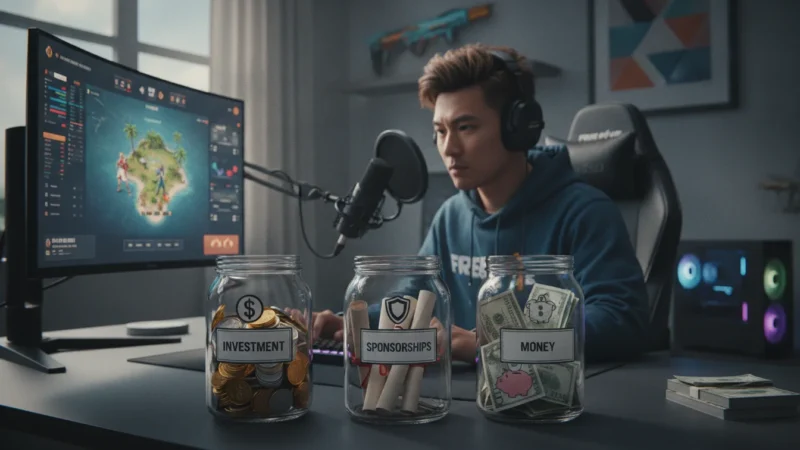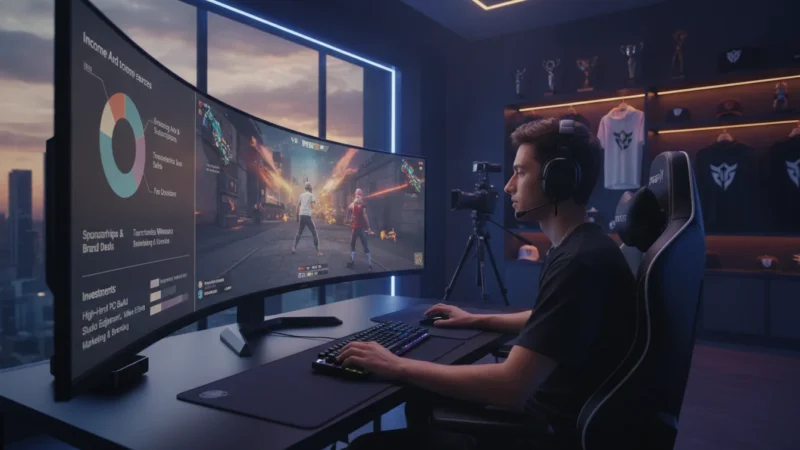
How Young Free Fire Creators Can Start Investing Even Earning Little
|
Getting your Trinity Audio player ready... |
Let’s get one thing straight from the beginning: you do not need to be earning thousands of reais per month to start building real financial wealth. The idea that investing is something reserved for people with fat bank accounts is one of the most damaging myths in personal finance — and it hits especially hard for young Free Fire content creators who are still in the early stages of monetizing their channels. The good news is that investing even earning little is not only possible, it is one of the smartest moves you can make right now, precisely because time is your most powerful financial asset.
Every real you invest at 17 or 19 years old has far more compound growth potential than the same real invested at 35.
This article is written specifically for young creators in the Free Fire ecosystem — streamers on Booyah, YouTubers grinding toward monetization, TikTokers building their first audiences — who are starting to see small but real income flowing in and wondering what to do with it beyond buying new skins or upgrading their setup. We’re going to talk about the mechanics of investing even earning little, the specific financial products that make sense for someone earning R$300 to R$2,000 per month from their content, and the mindset shifts that separate creators who build lasting financial security from those who spend everything as fast as it comes in. Let’s go.
Why Investing Even Earning Little Is the Most Powerful Decision a Young Creator Can Make
The financial principle at the heart of early investing is compound interest — and it is genuinely one of the most remarkable forces in economics. When you invest R$100 and it earns 10% annually, you don’t just earn R$10 next year; you earn 10% on R$110 the year after that, then 10% on R$121 the year after that, and so on. Over a decade, that original R$100 becomes R$259 without you doing anything additional.
Over 30 years, it becomes R$1,744. This is why investing even earning little at 17 or 20 years old mathematically outperforms investing large amounts at 40. Time does the heavy lifting — you just need to start.
For Free Fire creators specifically, there’s another layer to this equation. Content creator income is inherently volatile. The algorithm shifts, a game loses popularity, a sponsorship deal ends — and suddenly the income that felt stable disappears.
Young creators who learn to invest early develop the financial discipline and structural habits that protect them when those inevitable income fluctuations happen. Instead of panicking when a month’s AdSense drops 40%, the creator who has been consistently investing even earning little has a financial cushion and a growing asset base that provides genuine security. This psychological peace of mind is itself enormously valuable.
Understanding Your Income as a Creator Before You Invest

Before choosing any investment product, you need to understand the nature of your creator income. Unlike a salaried employee who receives a predictable amount on the same day every month, a Free Fire influencer’s income comes from multiple irregular sources — AdSense payments that depend on monthly views, brand deals that might arrive in lumps, live donation totals that vary by session, and affiliate commissions that fluctuate with audience behavior. This variable income structure requires a slightly different financial approach than standard personal finance advice assumes.
The first practical step is to track every real of creator income for at least two months before committing to an investment plan. Use a simple spreadsheet — Google Sheets is free and works perfectly for this — and record every payment by source: AdSense, TikTok, Kwai, brand deal, donations, merchandise, affiliates. At the end of two months, calculate your average monthly income and your minimum monthly income (the lower month).
Your investment commitment should be based on the minimum, not the average. This way, even in a bad content month, you can maintain your investment habit without financial stress. Consistency is what creates wealth, not the occasional large deposit.
You should also separate your income mentally into three buckets: operating expenses (equipment maintenance, internet, software subscriptions, video editing costs), personal living expenses (food, transport, any household contributions), and investable surplus. Many young creators underestimate their operating expenses because they don’t track them systematically. Once you’ve mapped all three buckets clearly, even a modest investable surplus of R$50–R$150 per month is enough to begin building real financial assets.
Don’t wait for the “right amount” — start with whatever the surplus honestly is.
The Best Investment Products for Young Free Fire Creators Starting Small
Brazil’s investment landscape has genuinely democratized over the past decade, and there are now excellent options available to someone investing even earning little. The days when you needed R$10,000 to open a brokerage account are over. Here’s a breakdown of the most appropriate products for early-stage creators with modest monthly surpluses, listed in order from most conservative to most growth-oriented.
Tesouro Direto — SELIC is the starting point for almost every Brazilian beginner investor, and for good reason. This is a government bond that tracks the SELIC rate (Brazil’s base interest rate), which has historically ranged between 6% and 13.75% annually.
The minimum investment is just R$30, there are no lock-up periods (you can redeem daily on business days), and it is the safest investment in the Brazilian financial system — backed by the federal government. For a Free Fire creator with an irregular income, having a chunk of savings in Tesouro SELIC means your emergency fund is both liquid and actually growing, rather than sitting in a savings account (caderneta de poupança) that typically pays less than inflation.
CDBs (Certificados de Depósito Bancário) are bank-issued fixed income products available through digital broker platforms like Nubank, Rico, XP Investimentos, and Inter. They pay a percentage of the CDI rate (usually 100–130% CDI for products available on these platforms), and many have minimum investments of R$100 or less. The key distinction to understand is liquidity: some CDBs are liquid daily, while others require you to hold until maturity (30 days, 6 months, 1 year, etc.
). For a young creator investing even earning little, starting with daily liquidity CDBs at 100–110% CDI provides safety, growth, and flexibility. As your investment habit solidifies and you build a proper emergency fund (3–6 months of expenses), you can begin allocating some funds to longer-term CDBs with higher rates.
Fundos de Renda Fixa (fixed income funds) available on platforms like Nubank’s NuFundo or XP’s funds offer automatic diversification within the fixed income universe and often have very low minimum contributions. While their fees (taxa de administração) slightly reduce returns compared to direct CDB or Tesouro Direto purchases, they offer simplicity — you contribute what you can monthly and the fund manager handles allocation. For creators who don’t want to think too much about the mechanics of investing while they’re focused on growing their channel, this auto-pilot approach has real value.
ETFs (Exchange-Traded Funds) are investment funds traded like stocks on the Brazilian stock exchange (B3), and they represent the most accessible entry point into variable income for beginners. The most popular for Brazilian investors include BOVA11 (which tracks the Ibovespa index, giving you exposure to the 80+ largest Brazilian companies in a single purchase) and IVVB11 (which tracks the S&P 500, giving you dollar-denominated exposure to the 500 largest US companies). A single share of BOVA11 or IVVB11 can be purchased for R$100–R$120, making them perfectly sized for young creators investing even earning little.
The key principle with ETFs is consistent monthly purchasing regardless of price — a strategy called dollar-cost averaging that smooths out market volatility over time.
Building Your Emergency Fund Before Anything Else
Here’s where many young investors — not just creators — make a critical mistake: they rush into ETFs and crypto before building an emergency fund, then have to sell their investments at a bad time when an unexpected expense hits. For a Free Fire creator, emergencies could be a broken gaming phone, unexpected medical costs, a family situation requiring money, or simply a terrible two months of content income. Without an emergency fund, you are one crisis away from liquidating your investments — often at a loss.
The rule of thumb is to maintain 3 to 6 months of essential expenses in a liquid, safe account before committing money to any investment with lock-up periods or market volatility. For a young creator living at home with parents, this might be as low as R$1,500–R$3,000 (if essential monthly expenses are R$500). For someone who is more financially independent, it could be R$6,000–R$12,000.
This emergency fund should sit in a Tesouro SELIC or a daily liquidity CDB at 100%+ CDI — not in a regular bank savings account, which pays less, and not in a stock account, which can lose value precisely when you need money most.
The practical approach for a creator investing even earning little is to split the investable surplus during the emergency fund building phase: put 70% toward the emergency fund and 30% into long-term investments. Once the emergency fund target is reached, redirect all surplus to growth investments. This two-track approach means you’re building security and growth simultaneously, rather than waiting until the emergency fund is complete to start any investing at all.
The compound interest clock starts ticking from the moment you make your first investment, so starting both tracks in parallel, even modestly, is smarter than sequencing them.
The Mindset of Paying Yourself First as a Creator
One of the most transformational personal finance concepts for self-employed people — and all Free Fire creators are, in effect, self-employed — is “pay yourself first.” The idea is simple: when money arrives in your account, before you buy anything, before you pay any bill, before you consider any upgrade to your setup, you transfer your predetermined investment amount to your investment account. The money never “passes through” your spending account in a way that tempts you to use it.
You live on what remains after investing.
This is especially important for creator income because irregular payments are psychologically dangerous to manage. When a R$2,000 brand deal arrives all at once after weeks of smaller AdSense payments, it feels like abundance — and our brains are wired to spend in moments of perceived abundance. The “pay yourself first” system short-circuits this by automating the investment before the psychological abundance reaction kicks in.
Set up an automatic transfer to your investment platform for the day after each expected payment, or manually transfer within 24 hours of every payment as a non-negotiable habit. Over time, investing even earning little becomes a reflex rather than a deliberate decision.
Another mindset shift worth making is reframing what “lifestyle upgrades” mean. Many young creators feel social pressure to upgrade their equipment constantly, buy new skins to stay relevant to their audience, or acquire the latest gaming gear to signal success. While some equipment investment is genuinely necessary (better audio quality, for example, dramatically impacts channel growth), a lot of creator spending is lifestyle inflation masquerading as business investment.
Before any major purchase, ask: will this directly and measurably improve my content quality or audience growth? If the honest answer is no, it’s a lifestyle expense — and lifestyle expenses should come after, not before, your investment contribution.
Investing in Yourself and Your Creator Business as a Form of Financial Strategy
When we talk about investing even earning little, we should also acknowledge that for a young Free Fire creator, some of the highest-return investments are made in the business itself — not in financial markets. Understanding which reinvestments generate the strongest return on audience growth and income multiplication is itself a financial skill. The strategic use of creator income to accelerate revenue growth can produce returns that dwarf any fixed income product in the short to medium term.
The highest-ROI business investments for early-stage creators typically include: a quality USB microphone (R$200–R$400, dramatically reduces viewer drop-off due to poor audio), a basic ring light (R$80–R$150, improves facecam quality substantially), and a Canva Pro subscription (R$55/month, enables professional thumbnails that significantly increase click-through rates). Notice these are all relatively modest investments with measurable impact. A channel growing faster because of better thumbnails reaches monetization thresholds sooner and generates more sponsorship income sooner — the compounding effect on business growth can be significant.
Beyond equipment, investing in knowledge has an outstanding return for young creators. A R$150 online course on YouTube SEO, video editing, or content strategy can unlock techniques that double a channel’s growth rate. Following creators who openly discuss business strategy — not just gameplay — exposes you to frameworks that take years to develop organically.
Platforms like YouTube itself host enormous amounts of free creator business education, and the time investment in consuming this content systematically is itself a form of investment that pays dividends in accelerated income growth. When you’re at the stage of investing even earning little in financial markets, accelerating your income growth is actually the most powerful lever you have.
Crypto, Stocks, and Riskier Assets: When and How to Approach Them
Let’s talk about the assets that tend to fascinate young creators the most: cryptocurrency, individual stocks, and other volatile investments. The appeal is obvious — stories of massive gains circulate constantly on social media, and the culture of gaming communities often overlaps with crypto enthusiasm. The honest advice here is nuanced: these assets have a legitimate place in a long-term portfolio, but only after you have a solid foundation of emergency savings and consistent fixed income investments established.
If you want to include cryptocurrency in your portfolio, the most responsible approach for a young creator investing even earning little is to limit crypto exposure to 5–10% of your total investment portfolio, and within crypto, to stick primarily to Bitcoin (BTC) and Ethereum (ETH) — the most established, most liquid, and most studied assets in the crypto space. Altcoins, meme coins, and new token launches are overwhelmingly speculative and have destroyed wealth for vast numbers of young investors. The FOMO (fear of missing out) that drives people into these assets is the same psychological mechanism that makes slot machines addictive.
Recognize it, and don’t let it override your financial strategy.
For individual Brazilian stocks, the same caution applies, but with additional nuance. Picking individual stocks requires significant research capacity and market knowledge that most beginners don’t have — and studies consistently show that even professional fund managers fail to outperform index funds over the long term. For young creators, ETFs like BOVA11 and IVVB11 provide stock market exposure with automatic diversification at minimal cost and effort.
If you genuinely want to research and invest in individual companies after understanding the basics, allocate no more than 10–20% of your stock market investments to individual picks, and invest the rest in broad index ETFs. This approach captures most of the market upside while limiting the damage of individual stock selection errors.
Practical Monthly Investment Plan for a Free Fire Creator Earning R$500
Let’s make this concrete with a real example. Suppose you’re a young Free Fire creator earning approximately R$500 per month from a combination of early AdSense income, small donations during live streams, and one or two affiliate commissions. After covering your personal expenses (which we’ll assume are low because you’re living at home and contributing R$150/month to household costs), you have approximately R$200 in monthly investable surplus.
Here’s how to allocate that R$200 intelligently while investing even earning little.
- R$140 (70%) → Emergency Fund (Tesouro SELIC or daily liquidity CDB): Until your emergency fund reaches R$2,000–R$3,000, prioritize building this safety net. Keep this money in a separate digital account from your spending money — out of sight, out of mind.
- R$40 (20%) → Long-Term Fixed Income (CDB 110% CDI, 1-year term): This starts your long-term investment base. Even though R$40/month seems small, 12 months of consistent deposits builds R$480+ before interest, and the habit is what matters most at this stage.
- R$20 (10%) → Variable Income ETF (IVVB11 or BOVA11): This small exposure to the stock market starts your equity investing habit and gives you hands-on experience with how markets move, which is educationally valuable as your income grows.
Once your emergency fund reaches its target, redirect the R$140 to long-term investments — perhaps R$80 to longer-term CDBs and R$60 to ETFs. As your creator income grows (to R$1,000, then R$2,000), you increase the investment amounts proportionally, maintaining the percentages. This percentage-based approach means the plan scales automatically with your income, and you never have to renegotiate with yourself about how much to invest — the system does it for you.
Tax Basics Every Young Creator Investor Needs to Know
One topic that most personal finance content glosses over for young investors is taxation — and ignoring it can be expensive. In Brazil, investment income has its own tax rules that vary by asset class. Tesouro Direto and CDBs are subject to IOF (a financial operations tax) if redeemed within 30 days, and Income Tax (IR) on gains at rates ranging from 22.
5% (for investments held less than 6 months) down to 15% (for investments held more than 2 years). This is calculated and withheld automatically by the platform when you redeem — you don’t need to calculate it yourself for these assets.
ETFs and stocks on B3 require you to file a monthly DARF (federal tax payment slip) if your total stock market sales in a month exceed R$20,000. Below that threshold, profits from stock sales are exempt from capital gains tax. For most early-stage creators investing even earning little, you’ll be far below the R$20,000 monthly sales threshold, so stock market investing is effectively tax-free at this stage.
However, any dividends received from stocks or ETFs need to be declared in your annual income tax filing (IRPF). Using a free tool like the IRPF software provided by the Brazilian Receita Federal each year, and reading the reports generated by your broker (which all reputable platforms provide automatically), makes this straightforward.
The Long Game: What Consistent Small Investments Look Like Over Time
Let’s end with some numbers that illustrate why investing even earning little is worth the discipline. Suppose you invest just R$150 per month starting at age 18, earning an average annual return of 10% (a conservative assumption given historical Brazilian fixed income rates). By age 28 — a decade later — your total contributions of R$18,000 have grown to approximately R$30,727.
By age 38, your contributions of R$36,000 have grown to approximately R$113,905. By age 48, your contributions of R$54,000 have grown to approximately R$340,969. The numbers compound dramatically over time — not because you invested huge amounts, but because you started early and stayed consistent.
Now imagine that as your Free Fire creator career grows and your income increases, you gradually increase your monthly investment from R$150 to R$300 at age 20, to R$600 at age 23, to R$1,200 at age 26. The compounding effect accelerates dramatically. This is not fantasy — it is the mathematical reality of consistent, disciplined investing beginning in your late teens and early twenties.
The young Free Fire creator who understands this and acts on it, even while investing even earning little in the beginning, is building a financial foundation that most people in their 30s and 40s wish they had started earlier.
Useful Resources and Platforms for Young Brazilian Creator Investors
- Tesouro Direto (tesouro.economia.gov.br): The official government platform to buy Tesouro SELIC and other government bonds directly, with R$30 minimum investment.
- Nubank (nubank.com.br): Offers daily liquidity CDBs at 100% CDI with no minimums, accessible directly from the app — ideal for building your emergency fund.
- Rico Investimentos (rico.com.vc): Zero-fee brokerage with access to CDBs, ETFs, Tesouro Direto, and stocks — one of the most beginner-friendly platforms in Brazil.
- XP Investimentos (xpi.com.br): Broader product selection including funds, ETFs, and CDBs from multiple issuers — better for when you’re ready to diversify further.
- Me Poupe! (YouTube channel and book): Nathalia Arcuri’s channel is the most widely recommended personal finance educational resource in Brazilian Portuguese, with content specifically designed for beginners.
- Primo Rico (YouTube channel): Thiago Nigro’s channel covers investing for Brazilians in depth, including stock analysis, ETFs, and practical financial planning.
- Investidor Sardinha (YouTube channel): Raul Sena’s channel is particularly strong on ETF investing and passive investing strategies — excellent for the systematic, low-effort approach recommended in this article.
- Google Sheets (sheets.google.com): Free income and expense tracking — build your own dashboard to monitor creator income by source and track investment progress monthly.
Frequently Asked Questions About Young Creators Investing on Low Income
Can I really start investing with R$30 or R$50 per month?
Yes, absolutely. Tesouro SELIC accepts investments from R$30, and many CDBs on platforms like Nubank have no minimum contribution. The habit and consistency matter far more than the initial amount.
R$50/month invested consistently for 10 years at 10% annually grows to approximately R$10,200 — from R$6,000 in total contributions.
Should I invest before or after buying better equipment for my channel?
Both, in proportion. Equipment that directly and measurably improves content quality (microphone, lighting) is a legitimate business investment with real ROI — it should come before financial market investing if it accelerates your income growth. But lifestyle upgrades and cosmetic improvements should always come after your investment contribution is made.
The key is being honest with yourself about which category each purchase falls into.
Is it safe to invest through apps like Nubank and Rico?
Yes. CDBs held through these platforms are protected by the FGC (Fundo Garantidor de Créditos) up to R$250,000 per institution per CPF, and Tesouro Direto is backed by the Brazilian federal government. These are not the same as keeping money in a fintech’s operating account — they are regulated investment products with legal protections.
What if my income drops suddenly and I can’t invest one month?
Skip that month without guilt and resume the following month. The worst outcome would be redeeming existing investments to “maintain” an investment habit — that defeats the purpose. Your investment plan should be sized so that your minimum income month allows contributions without stress.
If you consistently can’t contribute, the plan needs to be resized, not abandoned.
At what income level should I open a CNPJ to manage my creator finances?
When your creator income consistently exceeds R$1,903.98/month (the 2024 income tax exemption threshold for individuals), it’s worth consulting an accountant about whether a MEI or Simples Nacional company structure would reduce your total tax burden. For most early-stage creators earning under this amount, investing as an individual (CPF) is completely adequate and simpler to manage.
Is cryptocurrency a good investment for young creators?
Only after building your emergency fund and establishing a fixed income investment habit. And even then, limit crypto to 5–10% of your total portfolio, focusing on Bitcoin and Ethereum rather than speculative altcoins. Treat it as a high-risk, high-volatility component of a diversified portfolio — not as your primary wealth-building vehicle.
Now it’s your turn: are you already investing even earning little from your Free Fire content, or is this the first time you’ve seriously considered starting? What’s the biggest mental block stopping you from putting aside even R$50 this month? Drop your honest thoughts in the comments below — this community benefits from real conversations about money, and your question might be exactly what another young creator needs to hear answered. And if this article gave you something genuinely useful, share it with a fellow creator in your Free Fire community. Let’s normalize talking about money as openly as we talk about gameplay strategy.

My name is Alessandro Santos Souza, 47 years old, a tireless explorer of the digital universe. I am more than a content creator:
I am a true navigator of emerging technologies, with a burning passion for intelligence and innovation.