Satellite Cities and the New Urban Exodus: Where the Opportunities Lie in 2026
|
Getting your Trinity Audio player ready... |
The year 2026 marks a definitive turning point in how humanity chooses its habitat. We are no longer living in the shadow of the pandemic; instead, we have fully embraced its most significant legacy: the decentralization of work and life. As we navigate this era, the phenomenon of Cidades Satélites e o Novo Êxodo Urbano has shifted from a temporary trend to a permanent structural change in the global economy.
People are fleeing the suffocating costs and congestion of traditional “tier-one” megacities in search of a “Goldilocks” zone—places that offer the high-tech infrastructure of a metropolis with the tranquility and community of a smaller town. This migration is creating a new map of wealth, real estate opportunity, and lifestyle design that savvy investors and families are only beginning to decode.
For the modern professional, the choice of where to live is no longer dictated by the physical location of a corporate headquarters. The maturation of Starlink-style satellite internet, the normalization of 4-day work weeks, and the rise of autonomous regional transport have made the Cidades Satélites e o Novo Êxodo Urbano movement possible. We are seeing a massive redistribution of human capital.
Wealth is leaking out of expensive city centers and pouring into satellite hubs—cities located 50 to 100 miles away from major capitals. These areas are becoming the new engines of economic growth, offering a higher Quality of Life (QoL) without sacrificing career trajectory or technological connectivity. If you are looking to position yourself for the next decade of growth, understanding this shift is essential.
In this deep dive, we will explore why these secondary cities are becoming the primary targets for investment. We aren’t just talking about “suburbs” in the old sense of the word. We are discussing the rise of self-sustaining ecosystems that offer their own cultural identities, healthcare facilities, and tech hubs.
The Cidades Satélites e o Novo Êxodo Urbano represents a search for resilience. In an age of climate uncertainty and economic volatility, the ability to live in a less dense, more resource-efficient environment is becoming the ultimate luxury. Whether you are a real estate investor, a remote worker, or an entrepreneur, the insights shared here will help you identify exactly where the opportunities are ripening in 2026.
The Economic Drivers Behind the Cidades Satélites e o Novo Êxodo Urbano
To understand the current surge in Cidades Satélites e o Novo Êxodo Urbano, one must look at the “Affordability Gap.” By 2026, the cost of living in hubs like New York, London, or São Paulo has reached a breaking point for the middle class. When a family spends 50% of its income on a cramped apartment, the value proposition of the big city collapses.
Satellite cities offer a release valve. These regions provide much lower land costs, which translates into larger homes, private gardens, and better-funded local services. This economic migration is creating a “virtuous cycle”: as more professionals move to these satellite areas, local tax bases grow, leading to better schools and infrastructure, which in turn attracts even more high-value residents.
Another major driver is the Regional Tech Hub Decentralization. Large corporations have realized that they don’t need everyone in one building; they need “nodes.” In 2026, we see companies setting up micro-offices in satellite cities, allowing employees to commute only once or twice a month while maintaining a physical connection to the brand.
This hybrid model has supercharged the Cidades Satélites e o Novo Êxodo Urbano, as it removes the last bit of friction for those hesitant to leave the city. This isn’t a retreat from technology; it’s a more efficient deployment of it. Investors who recognize which satellite cities are being chosen as these “corporate nodes” stand to gain significantly from early property acquisitions.
The role of Infrastructure 4.0 cannot be overstated. The development of high-speed rail links and the proliferation of vertiports for electric vertical take-off and landing (eVTOL) aircraft have effectively “shortened” distances.
A city that was once a grueling three-hour drive from the center is now a forty-minute comfortable transit ride away. This connectivity is the lifeblood of Cidades Satélites e o Novo Êxodo Urbano. When physical distance is mitigated by technological speed, the geographic premium of the city center evaporates.
In 2026, we are valuing “time-to-hub” rather than “distance-to-hub,” and satellite cities that have invested in modern transport are winning the race for new residents.
Sustainable Urbanism and the Quality of Life Premium
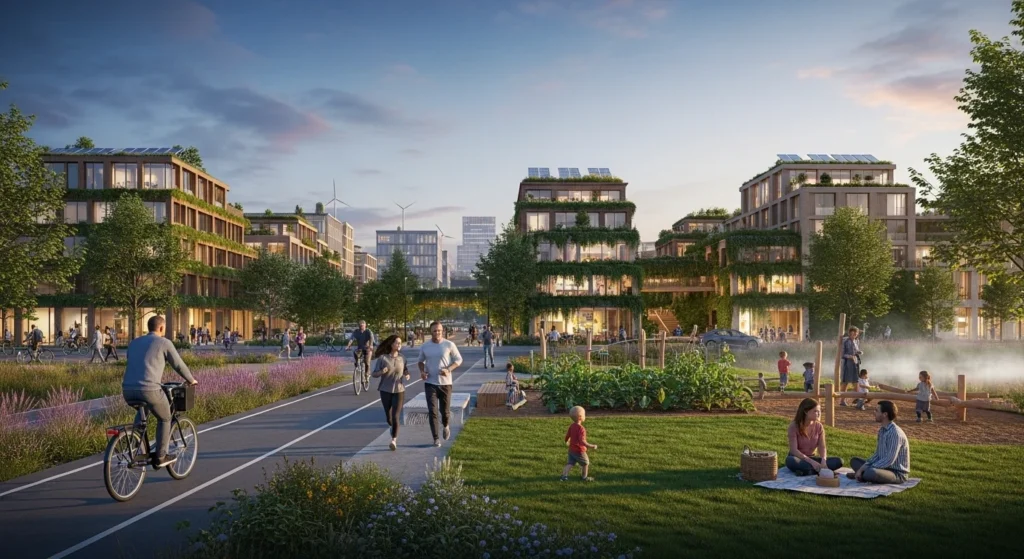
One of the most profound aspects of Cidades Satélites e o Novo Êxodo Urbano is the shift toward “Biophilic Living.” Modern workers in 2026 are increasingly prioritizing mental health and access to nature. Satellite cities are often designed with more green space, “15-minute city” layouts where everything is reachable by bike, and a lower noise-pollution index.
This is the Quality of Life Premium—a factor that has become a primary metric for real estate valuation. People are willing to pay more for a home that integrates with the landscape rather than one that hides from it. This trend is driving a boom in “Agri-hoods”—residential developments built around working organic farms.
Sustainability is no longer a marketing buzzword; it is a financial necessity. As energy costs remain volatile, the Cidades Satélites e o Novo Êxodo Urbano movement is favoring regions that offer localized energy grids and water security. Many satellite cities are being built from the ground up or retrofitted with 2026 technology, making them far more energy-efficient than aging megacities.
For the inhabitant, this means lower utility bills and a smaller carbon footprint. For the investor, it means assets that are “future-proofed” against upcoming environmental regulations and carbon taxes. Living in a satellite city is increasingly seen as a way to opt-in to a more sustainable and resilient lifestyle.
Furthermore, the social fabric in these areas is often tighter. The Cidades Satélites e o Novo Êxodo Urbano is fostering a “New Localism.” In massive cities, residents often feel anonymous and isolated.
In satellite hubs, there is a clearer sense of community, with local markets, community-supported agriculture, and neighborhood-level governance. This social capital is a major draw for families and retirees alike. In 2026, we’ve learned that digital connection is great, but physical community is essential.
The opportunity here lies in businesses that cater to this localism—boutique services, community spaces, and local logistics that keep the satellite city self-sufficient and vibrant.
Investment Strategies for the Decentralized Real Estate Market
When looking for opportunities within the Cidades Satélites e o Novo Êxodo Urbano, the first rule is to “Follow the Fiber.” In 2026, real estate value is directly correlated with bandwidth. A beautiful home in a satellite city is worthless to a modern professional if the internet connectivity is spotty.
Savvy investors are looking for “Smart Cities” that have integrated 6G nodes and high-speed fiber into their municipal planning. These are the areas that will maintain their value. The digital infrastructure of a satellite city is now as important as its plumbing.
Investing in properties that are “remote-work ready” with dedicated office suites and soundproofing is a surefire way to command higher rents.
Another high-growth area is Adaptive Reuse of Suburban Retail. As shopping habits have moved almost entirely online, many old suburban malls in satellite regions are being converted into mixed-use “lifestyle centers” that combine housing, co-working spaces, and entertainment. This is a key part of the Cidades Satélites e o Novo Êxodo Urbano infrastructure.
Investors should look for these conversion projects, as they often become the new “downtown” of the satellite city. They provide the urban amenities people miss from the big city—like high-end coffee shops and specialized gyms—but in a more accessible and relaxed setting. This “urban-lite” experience is exactly what the 2026 migrant is looking for.
Lastly, don’t ignore the Short-Term Rental and Tourism Hybrid. Many people participating in the Cidades Satélites e o Novo Êxodo Urbano don’t move permanently at first. They “test-drive” these cities through mid-term rentals (1-3 months).
Properties that cater to this “try-before-you-buy” crowd are incredibly lucrative. By providing a “turn-key” experience—fully furnished, high-speed internet, and local guides—you can tap into the flow of people moving out of the megacities. This segment of the market is less sensitive to price and more focused on the experience of the new locale, making it a high-margin opportunity for property managers and individual investors alike.
Technological Enablers of Remote Work and Regional Growth
The success of Cidades Satélites e o Novo Êxodo Urbano is intrinsically linked to the Virtual Presence Evolution. By 2026, we have moved beyond clunky video calls into high-fidelity spatial computing and holographic meetings. This technology has effectively “killed” the cubicle.
If you can sit in your home office in a satellite city and feel as though you are in a room with your colleagues in London or New York, the geographical advantage of being in the city center disappears. This tech allows the “Exodus” to include even the highest levels of management and creative roles, which were previously tethered to urban headquarters. This is a massive shift in the demographics of satellite cities.
We are also seeing the rise of Decentralized Professional Services. In the past, if you wanted the best lawyers, accountants, or consultants, you had to look in the heart of the financial district. Today, the Cidades Satélites e o Novo Êxodo Urbano has distributed this talent.
High-end service providers are setting up shop in satellite hubs to enjoy a better lifestyle, and they are taking their clients with them. This creates a secondary market for commercial real estate in satellite cities: boutique professional offices. These spaces need to be high-end and technologically advanced, catering to a sophisticated clientele that expects big-city quality without the big-city commute.
Logistics and Autonomous Last-Mile Delivery have also solved one of the biggest complaints about leaving the city: convenience. In 2026, drone delivery and autonomous robots have made it so that living in a satellite city doesn’t mean waiting three days for a package. You can get almost anything delivered to a satellite address within hours.
This “convenience parity” is the final nail in the coffin for urban overcrowding. When you can have the quiet of the countryside and the delivery speed of the city, the choice becomes obvious. The Cidades Satélites e o Novo Êxodo Urbano is built on this foundation of technological invisible-hand services that make remote living feel effortless.
The Challenges and Risks of the New Urban Exodus
While the Cidades Satélites e o Novo Êxodo Urbano offers immense opportunity, it is not without its risks. The most significant concern is “Satellite Gentrification.” As wealthy urbanites move into smaller communities, they often drive up property prices and taxes, potentially displacing the original residents.
This can create social tension and political instability. For an investor, it is crucial to look for satellite cities that have inclusive zoning laws and “workforce housing” initiatives. A city that is only affordable for the top 5% is not a resilient community; a city that maintains a diverse economic base is a much safer long-term bet.
There is also the risk of Infrastructure Lag. Some satellite cities are growing faster than their ability to provide services. If a city’s population doubles in three years, but its water system, roads, and hospitals remain the same, the quality of life will plummet.
When evaluating the Cidades Satélites e o Novo Êxodo Urbano, look at the municipal government’s track record. Are they proactive? Do they have a clear 10-year growth plan? Investing in a “boom town” without a plan is a recipe for disaster. You want to be in a city that is growing by design, not by accident.
Check for upcoming public works projects and debt ratings before committing significant capital.
Finally, consider the “Recall to Office” Risk. While remote work is the standard in 2026, some industries may attempt to force a return to the center. However, the Cidades Satélites e o Novo Êxodo Urbano has gained so much momentum that any company attempting this usually faces a mass exodus of talent.
The “Power of the Employee” is at an all-time high. Nevertheless, it is wise to choose satellite cities that have their own diversified local economies. If a city is 100% dependent on residents who work for one specific tech company in a distant megacity, it is vulnerable.
A resilient satellite city should have its own local businesses, schools, and industries to fall back on.
Checklist for Identifying a High-Potential Satellite City
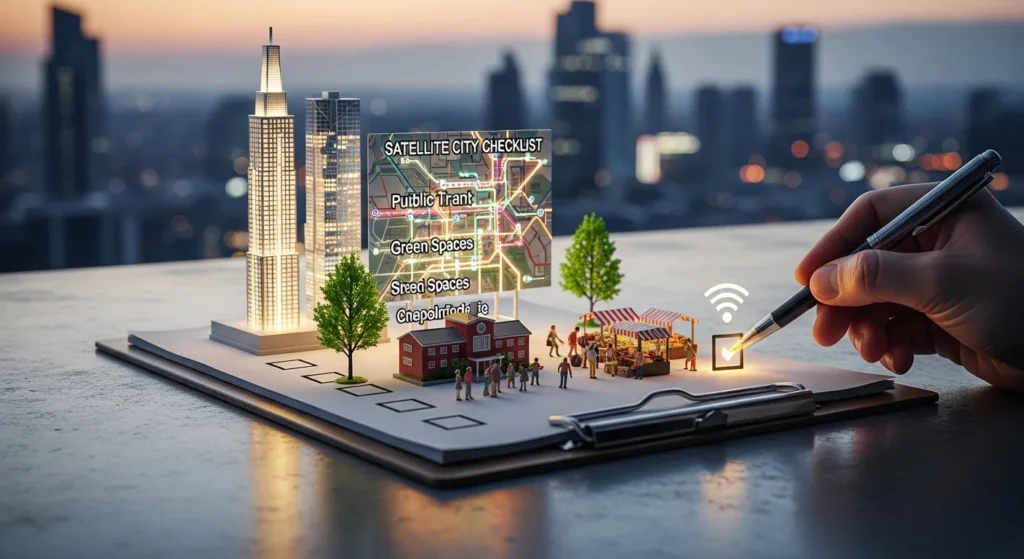
- Connectivity: Does the city have 6G coverage, fiber-to-the-home, and proximity to regional transport hubs?
- Governance: Is the local government pro-growth? Look for tax incentives for remote workers and PropTech startups.
- Amenities: Does it have high-quality healthcare, “third spaces” like co-working cafes, and cultural venues?
- Sustainability: What is the city’s plan for water and energy security over the next decade?
- Demographics: Is the city attracting a diverse mix of young professionals, families, and “silver” retirees?
The Cidades Satélites e o Novo Êxodo Urbano is more than a change in address; it’s a change in the human operating system. We are learning to live with more space, more intention, and more connection to our immediate surroundings. The opportunities in 2026 are not found in the shadows of skyscrapers, but in the sunlit streets of the emerging satellite hubs.
By focusing on technology, sustainability, and community, you can find a place that is not just an investment, but a home for the future.
As we look toward the second half of this decade, the distinction between “urban” and “suburban” will continue to blur. The Cidades Satélites e o Novo Êxodo Urbano will likely evolve into a network of “Smart Nodes,” where each city specializes in a certain industry or lifestyle. The winners will be those who can navigate this new decentralized world with agility and foresight.
The exodus is here, and the map of the world is being redrawn one satellite city at a time. Are you ready to claim your spot in the new landscape?
What do you think? Is the move to satellite cities a permanent shift, or will the “gravity” of the big city eventually pull people back? Have you considered moving to a satellite hub yourself? Share your thoughts in the comments below!
Frequently Asked Questions (FAQ)
1. What exactly is a “Satellite City”? A satellite city is a smaller metropolitan area located near a large megacity but maintaining its own independent municipal government, local economy, and services. In 2026, they are often characterized by high-tech infrastructure and a focus on quality of life.
2. How does the “New Urban Exodus” affect property values in megacities? While megacities are seeing a slowing of growth, they aren’t dying. Instead, they are becoming “premium hubs” for luxury living and specialized services, while the middle class and remote workers fuel the Cidades Satélites e o Novo Êxodo Urbano.
3. Is it risky to buy property in a satellite city? Like any investment, it has risks. The key is to look for “planned growth.
” Avoid areas that lack digital infrastructure or have poor transport links to the main hub. Fiber-optic internet is the most important utility in 2026.
4. Can I still have a high-flying career from a satellite city? Absolutely. With the advancement of spatial computing and decentralized management, your physical location has very little impact on your ability to lead large teams or close major deals.
The “Executive Exodus” is a major part of this trend.
5. What is the “15-minute city” concept in satellite hubs? It is an urban planning design where every resident can access their basic needs—groceries, school, healthcare, and parks—within a 15-minute walk or bike ride from their home. Many satellite cities in 2026 are adopting this to attract health-conscious residents.

My name is Alessandro Santos Souza, 47 years old, a tireless explorer of the digital universe. I am more than a content creator:
I am a true navigator of emerging technologies, with a burning passion for intelligence and innovation.